Trust Scoring for Web Content: How AI Helps You Navigate Information
The Information Challenge
We live in an age of information abundance. Any claim, any perspective, any 'fact' can be found online—along with its contradiction. Navigating this landscape requires new tools and approaches.
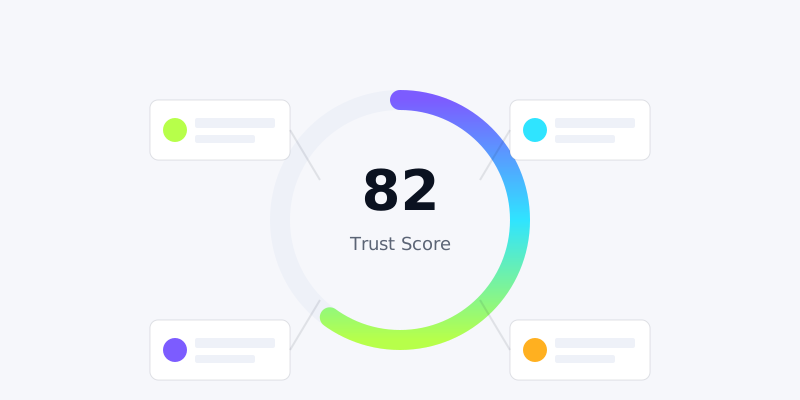
Trust scoring provides a systematic way to evaluate content credibility. Instead of relying on gut feelings or familiar sources, you get evidence-based assessments.
How Trust Scoring Works
AI-powered trust scoring examines multiple factors: source reputation, citation quality, consistency with established facts, writing quality, and potential bias indicators.
No single factor determines trustworthiness. Instead, the system synthesizes multiple signals to provide a holistic assessment.
Evidence Over Opinions
Good trust scoring shows its work. Rather than just providing a number, it explains why content received a particular score and what evidence supports that assessment.
This transparency allows you to evaluate the scoring itself. You can agree or disagree with specific factors while still benefiting from the systematic analysis.
Limitations of Trust Scoring
Trust scoring is a tool, not an oracle. It can miss context, misinterpret nuance, or give false confidence to flawed assessments.
The goal isn't to outsource your critical thinking but to augment it. Use trust scores as one input among many in evaluating information.
Building Information Literacy
Perhaps the greatest value of trust scoring is educational. By seeing how content is evaluated, you develop better intuitions for assessing credibility yourself.
Over time, you may find you rely less on automated scoring and more on your own enhanced judgment. That's the ultimate goal: informed, critical readers who can navigate the information landscape independently.